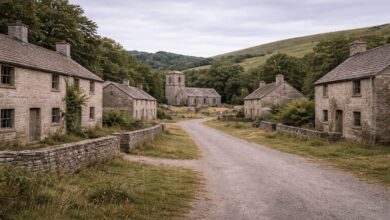
On the arid outskirts of Jaisalmer, the ruins of Kuldhara sit quietly against the Thar Desert. Stone houses stand roofless yet orderly. Streets remain legible. Wells, temples, and courtyards mark a community that once functioned with precision. According to historical records and local oral history, Kuldhara was abandoned abruptly in the early nineteenth century. No single, verified explanation accounts for the departure. What remains is an intact outline of daily life without the narrative that usually explains its end.
Kuldhara is often framed as mysterious or haunted, but its significance lies in something more grounded. It is a case where documentation is partial, memory is strong, and conclusions resist certainty. The village does not conceal ruins beneath sand. It presents them openly, inviting observation rather than spectacle.
A planned village in a demanding landscape
Kuldhara was established by members of the Paliwal Brahmin community, known for agricultural skill and water management in harsh environments. The village was carefully planned. Homes were aligned along defined streets. Drainage channels and step wells managed scarce water resources. Fields beyond the settlement supported crops adapted to desert conditions.
This planning reflects long term intention. Kuldhara was not a temporary camp. It was built to endure in a difficult climate through organization and cooperation. Similar human responses to silence and environment appear in village of Portlock.
Community structure and daily life
Life in Kuldhara followed predictable rhythms shaped by season, water availability, and social structure. Houses were built from local stone, designed to regulate temperature. Courtyards supported domestic activity. Temples anchored religious and communal life.
Oral histories describe a prosperous settlement with ties to nearby villages. Kuldhara was part of a network rather than an isolated outpost. Its residents were accustomed to negotiating with environment and authority alike.
This context matters when considering the nature of its abandonment.
The record of departure
Historical accounts suggest that Kuldhara was abandoned around 1825. According to these records, residents left in a coordinated manner, reportedly overnight. No evidence of conflict, fire, or environmental catastrophe has been identified at the site.
What distinguishes Kuldhara is not simply that it was abandoned, but that the departure appears collective and decisive. Homes were not dismantled. Infrastructure was not repurposed. The village was left intact.
Such coordination implies a shared cause, yet no official document names one conclusively.
Oral history and interpretation
Local oral tradition offers explanations that vary by teller. Some accounts describe oppressive taxation or abuse by regional authorities. Others speak of social injustice that made continued residence untenable. These narratives are consistent in theme but inconsistent in detail.
Oral history preserves emotional truth even when specifics shift. It reflects how communities remember reasons for departure, not necessarily how events unfolded precisely.
The absence of written confirmation leaves these accounts open rather than resolved.
Administrative pressure as a possibility
One plausible explanation discussed by historians involves administrative or economic pressure. In early nineteenth century Rajasthan, local governance could be arbitrary. Communities without political protection were vulnerable.
If conditions became intolerable, relocation may have been the most viable option. Coordinated departure would have minimized individual risk.
This interpretation aligns with known regional patterns, though it cannot be proven definitively for Kuldhara alone.
Why an overnight departure matters
Abandonment over time leaves gradual traces. Structures are altered. Materials are reused. Kuldhara shows little of this. The village appears paused rather than eroded.
An overnight departure suggests urgency or agreement. It implies that remaining was perceived as more dangerous than leaving with little preparation.
That perception, regardless of cause, shaped the outcome.
The absence of environmental triggers
Unlike many desert settlements, Kuldhara does not show clear evidence of drought, flood, or seismic damage corresponding with its abandonment. Water systems appear functional. Agricultural land remains identifiable.
Environmental hardship alone does not explain the timing. This absence reinforces uncertainty.
When common explanations fail, narrative fills the gap.
Preservation through aridity
The desert climate contributed to Kuldhara’s preservation. Low rainfall and stable soil limited structural collapse. Stone walls endured. Street layouts remained visible.
This preservation intensifies impact. Visitors can read the village spatially. The plan remains clear even as roofs and woodwork are gone.
The environment did not erase Kuldhara. It kept it legible.
The emergence of a cursed identity
Over time, Kuldhara became associated with the idea of a curse. According to some retellings, the departing residents declared the site uninhabitable to prevent reoccupation.
There is no historical evidence confirming such a declaration. However, the belief persists locally and influences how the site is approached.
Curses often function as narrative closures when factual ones are absent. They explain why a place remains empty.
Fear and respect
Whether or not a curse was ever spoken, Kuldhara was not resettled. Nearby communities avoided permanent occupation. This avoidance reinforced the story.
Fear does not require proof to persist. It requires repetition and social agreement.
Over generations, absence became confirmation.
Archaeology and restraint
Archaeological work at Kuldhara has been limited. The site is protected, but not extensively excavated. Much remains beneath surface level.
This restraint preserves integrity but also maintains uncertainty. Without intrusive study, some answers remain inaccessible.
The village retains its outline rather than its explanation.
Walking the ruins today
Visitors to Kuldhara encounter silence rather than decay. Streets guide movement. Doorways frame empty interiors. The absence of clutter or collapse is striking.
The site does not feel violent. It feels deliberate.
This quality distinguishes Kuldhara from ruins shaped by disaster.
Comparison with other abandoned villages
Across Rajasthan and elsewhere, villages were abandoned for many reasons: water scarcity, trade shifts, conflict. Most show signs of gradual departure.
Kuldhara’s coordinated emptiness sets it apart. It resembles a decision rather than a failure.
That distinction sustains attention.
Memory anchored in place
Kuldhara survives in memory because its physical form anchors story. The village offers a complete setting without a final chapter.
This invites interpretation. Each visitor brings explanation to absence.
The site does not contradict those explanations. It accommodates them.
Why Kuldhara endures
Kuldhara endures because it resists closure. It presents evidence of life without evidence of end. That imbalance keeps questions active.
The village does not demand belief in the supernatural. It demonstrates how uncertainty becomes cultural inheritance.
Its power lies in what cannot be verified.
Between record and silence
Historical records confirm abandonment. Oral history provides motive without confirmation. Archaeology preserves structure without narrative.
Together, these elements form an incomplete picture.
Kuldhara exists in the space between them.
A settlement defined by decision
Ultimately, Kuldhara was not destroyed. It was left. That choice defines its legacy.
The reasons may never be fully known. What remains is the result of collective action under perceived threat or injustice.
The village stands as evidence of that decision.
A quiet conclusion without explanation
Kuldhara does not offer answers. It offers continuity without context.
A village abandoned overnight according to records and oral history, it remains intact without explanation. Its streets hold memory without testimony. Its walls stand without voice.
In the desert near Jaisalmer, Kuldhara persists not as a mystery to solve, but as a reminder that some human decisions leave traces without records. The silence is the story. Related reflections on memory and perception can also be found in Pyramiden.
Horizon Report documents places shaped by memory, infrastructure, and human decisions. Our editorial approach focuses on what remains physically visible, how abandonment unfolds over time, and how interpretation is clearly separated from observable evidence.
For readers seeking deeper context, the following background articles explore how ghost towns emerge, why communities are left behind, and why preservation matters in understanding collective history.
- Abandonment And Ghost Towns
- What Is A Ghost Town
- Why Towns Are Abandoned
- Preserving Abandoned Places
Editorial transparency matters. Observations are grounded in site layout, materials, remaining structures, and documented timelines where available. Interpretive layers are presented as interpretation, not assertion.
Careful readers often notice details worth refining. Thoughtful feedback helps ensure accuracy, clarity, and long term editorial integrity.